Spring 2026
4
Coloring Outside the Lines: Reflections on the Outside Experience
Kerry Heckman, Editor (Class of 2026)
Coloring Outside the Lines: Reflections on the Outside Experience
Kerry Heckman
Editor
Class of 2026
One of the unique features of RWW is the Outside Experience. During the second year of the program, students participate in individual projects for 100 hours to further their learning about the writing life and craft. The possibilities for the OE are endless: travel, residencies, classes, projects, independent learning—almost anything a writer’s imagination can conceive. Here, two thesis-year students reflect back on the OE and how it enhanced their lives as writers.
***
 Play as a Discipline: Flying Squirrel, AWP, and Language Learning
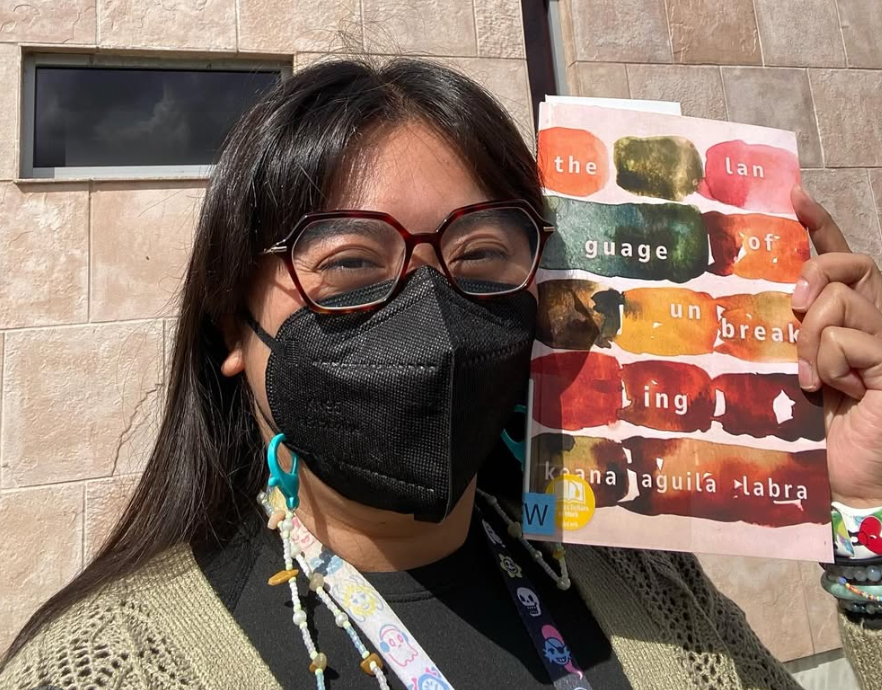
by Keana Aguila Labra
Modern life tends to be busy, and these days fraught, but we hold steady and continue on regardless. Despite the chaotic nature of life, the Outside Experience gave me permission to make time for play. I thought, “What are activities or practices that can provide fuel to my craft?”
For those of us who have read and/or heard of The Artist's Way by Julia Cameron, one of the lessons imparted to the reader is to spend time with an art outside of your own. This gave me inspiration for my Outside Experience—to use this opportunity to not only inform my work, but to learn something new as well.
Inevitably, chaos found its way into my Outside Experience, as I endeavored upon many activities. For those who know me (and my diagnosis), there really wasn't any other way to do it! I spent one week at Flying Squirrel Studio, reading and working on the manuscript for my creative thesis. In my personal life, I'm one of the caretakers for my Lola, so it was nice to have a break away from what feels like a harried, frenetic schedule, taking walks to the beach, or around the block, or not even taking walks at all. Maybe what was most calming, almost meditative, was the contradictory noise and silence of the cabin, the sound of the rain or the wind, and the sound of nothing besides my heart and my jiggling, anxious leg.
Next, I supported both Kaya Press and Sampaguita Press at the 2025 AWP Conference. I spent a total of five days in Los Angeles. Before the conference, I helped set up and take an accounting of inventory. During the conference I tabled, which gave me the opportunity to work with staff from other presses and gave me insight into networking with other writing professionals, and I signed copies of my first full-length poetry collection, The Language of Unbreaking.
Los Angeles is also the city my mother first immigrated to in her adolescence, so I sat with the city. I listened to it. I looked for my mother in the buildings, in the wind, in the sky. I wondered how the newness felt on her skin, for someone so young to have moved without her parents. Were her eyes wide with wonder, or was it fear? I looked at this city and found her breath, and I hoped to bring this discovery of my mother into my poetry as well.
Next for my OE, Tagalog lessons brought me closer to understanding my family’s homeland (and better communicating with my family still in the Philippines!). Being able to communicate in another language gives a new perspective on the ways we write and how we can change up the execution in our poetic narratives and images. I began, and continue to seek, new forms to play with different grammatical structures, such as Noor Ibn Najam’s colonial fit poetic form.
Most importantly, it was refreshing to learn new things. There is a pressure to do well and succeed with poetry, and that pressure still exists, but the ability to play and allow myself to be a beginner in a new art form invigorated my poetry and allowed me to look at my writing with fresh eyes. Overall, it was incredibly exciting to pursue creative adventures because of the Outside Experience. I’ve felt at home in places so far from my actual home, from taking Seattle’s water taxi for the first time and walking the streets of Los Angeles after the conference. It is that wonder and joy of the world that makes writing so vital; writing is an expression of our experiences and our humanity.
Keana Aguila Labra (they/them/she/her) is a Cebuana Tagalog Filipinx poet, essayist, playwright, and writer in diaspora residing on stolen Ohlone Tamyen land. Their first full-length poetry collection, The Language of Unbreaking, was released with Sampaguita Press.
 Ultra Stickers Everywhere: Research Trip to Germany
by Travis Timmons
During my first year in RWW (with Justin St. Germain as my mentor), I drafted a novel partially set in Germany around soccer “ultras,” the passionate die-hards responsible for unforgettable match atmospheres in Germany. Prior to focusing on fiction, I’d spent about a decade as a sports writer covering the German Bundesliga (professional soccer league) and learning German. So for my OE, I traveled to Germany with four of my brothers at the end of February 2025 for eight days. During the trip, we visited Frankfurt, Stuttgart, Munich, Nürnberg, and the German Alps.
I followed the advice of Rebecca Makkai and others, who recommend drafting material before you visit specific locations in order to frame your trip through the eyes of your work. This strategy worked brilliantly! Ahead of time, I made a list of key locations from my draft, such as the Hauptbanhof, the Königstrasse district, and the old town hall in Stuttgart, as well as doner shops, the Zeitgeist café, the Lenbachhaus museum, LLM University, and especially the Herz Jesu Kirche in Munich. I took extensive notes and photos, sometimes even reenacting walks my characters take. The trip’s highlight was attending a VfB Stuttgart-Bayern Munich match and watching the ultras do their glorious thing.
Why take a research trip? Sure, Google Maps Street View and other online sources can provide tons of information; however, it’s only being on the ground you can absorb details like smells, sounds, and the ubiquitous stickers soccer ultras put up everywhere in German cities. I took dozens of photos of these stickers, which act like a sort of secret language declaring who’s been where around the European soccer scene. And Street View can’t provide experiences like the hilarious and intense stadium restroom queue with hundreds of jubilantly drunk German men who told jokes, shamed line-cutters, and straightened hoods on our coats, or the raucous tram ride from the stadium when the conductor slammed the brakes and I fell, nearly tearing my Achilles tendon (I still have scar tissue!) because passengers wouldn’t stop vaping. The trip was a precious gift for my writing.
But international travel isn’t cheap, so here are some tips for research trips:
- Travel during the off-season. We saved a lot of money by traveling during the off-season (the trip cost me less than $3,000 for everything and, although I still had to teach an extra class to pay for it, the off-season savings meant we could do a lot more during the trip itself). Added bonus: there are fewer tourists!
- Plan in advance. A year in advance, we planned for the trip over a shared Google Doc, and we were able to time it during my spring break around a soccer match.
- Embrace the language. Take the language part of your experience seriously. Being immersed in German for eight days and practicing German every time I spoke to someone was my favorite part of the trip. My sister-in-law, a seasoned international traveler, encouraged me to be brave and make a lot of language mistakes. She was right. Funny language moments both created material for my novel and opened the door for fascinating conversation, such as being yelled at by German moms on a high-speed DB train who then profusely apologized when they realized we were English speakers, or speaking to Turkish shopkeepers who only spoke colloquial German for our tea and dessert orders, or talking with a bookshop seller who discussed his deep love for the USA despite our current political climate. Within such encounters, the self can, paradoxically, contract and expand, rubbing against and even flowing through linguistic borders.
Born and raised in Santa Fe, Travis Timmons is a community college professor living in Pittsburgh, PA, who mostly writes fiction and also poems about Costco.